

New research says infrared sauna may help athletes recover faster.
If you train in Austin, you already know the recovery challenge is real. Whether you're logging miles on the Barton Creek Greenbelt, grinding through a Wednesday morning track session, or lifting heavy at a local gym, the time between workouts matters as much as the workouts themselves. And lately, a growing stack of peer-reviewed research is pointing to infrared sauna as a tool worth taking seriously for that in-between time. This is not a hype piece. We are going to walk through what a major new study actually found, where the science still has gaps, and why we think the research is worth your attention if you train here in Central Texas.
What the 2025 study looked at
Earlier this year, researchers at the University of Jyväskylä in Finland published a controlled trial in Frontiers in Sports and Active Living, one of the more respected journals in applied sports science. The study followed 40 female team-sport athletes over six weeks of structured resistance training. Half the group used an infrared sauna after each training session; the other half rested passively.
The researchers measured neuromuscular performance through sprint tests, jump height assessments, and isometric strength checks. They also tracked body composition using dual-energy X-ray absorptiometry and ultrasound imaging of muscle tissue.
Here is what they found: the athletes who used infrared sauna after training recovered faster between sessions. The results showed that infrared sauna exposure helped prevent decline in jump performance, reduced muscle soreness, and improved perceived recovery. News-Medical When used consistently across the full six weeks, infrared sauna enhanced loaded jump performance and maximum sprint speed over the first few meters more effectively than training alone. News-Medical
What the study does not claim
This is where we want to be honest with you, because we think the nuance matters.
The study did not find that infrared sauna builds more muscle on its own. Post-exercise infrared sauna significantly improved neuromuscular recovery and reduced muscle soreness in 40 athletes over 6 weeks, but it did not increase muscle growth. Saunacloud The researchers noted that the performance gains likely came through improved training quality, not direct changes to muscle tissue. Put simply: when athletes recover better, they can train better in the next session, and that compounds over time.
The study also had a relatively small sample and focused on female team-sport athletes specifically, so we cannot assume the findings transfer identically to every training population. More research is needed on different athlete types, session durations, and intensity levels.
Why this matters for Austin athletes
Austin's training culture is serious. We have one of the deepest running communities in Texas, a cycling scene that keeps going year-round, and a strength and CrossFit culture that does not take weekends off. The challenge most local athletes face is not motivation. It is managing cumulative fatigue across a week of double sessions, long runs, and busy work schedules.
That is the gap infrared sauna may fill. The Finnish research suggests the benefit comes not from a single dramatic session but from consistent use over weeks. The positive effects of short-term infrared sauna exposure on long-term performance development do not appear to stem from direct physiological changes in the muscles, but more likely from improved training quality. MedicalXpress
For the runner finishing a long Sunday effort, the cyclist logging back-to-back days, or the lifter who needs to be sharp again on Thursday, the ability to show up to the next session feeling less beaten up is a real competitive advantage.
How infrared sauna works, in plain terms
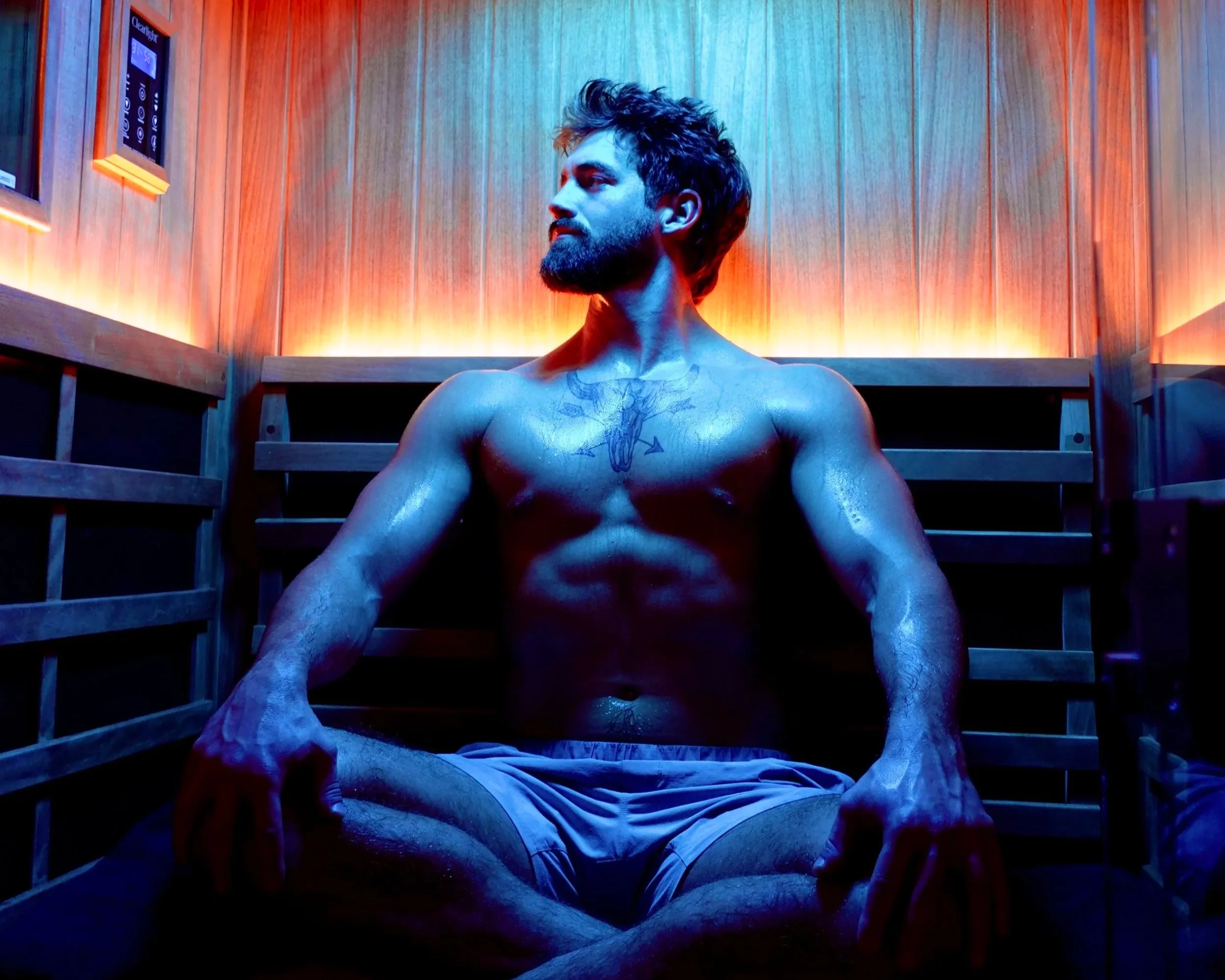
Unlike a traditional sauna, which heats the air around you to very high temperatures, an infrared sauna uses light-based heat that penetrates more directly into muscle tissue. Sessions typically run at lower ambient temperatures, which most people find more tolerable for longer periods.
During a session, your core temperature rises modestly, your heart rate increases to a level comparable to light cardiovascular activity, and your body initiates several heat-related responses: increased circulation to working muscles, activation of heat shock proteins that assist in cellular repair, and a reduction in certain inflammatory markers.
None of these mechanisms are exclusive to infrared. But the combination of a more tolerable session temperature and meaningful tissue-level heat exposure is why researchers have been interested in the infrared format specifically for post-exercise use.
Red light therapy and recovery: the companion tool
Many of our members pair infrared sauna sessions with red light therapy, and that combination is worth mentioning here. Red light therapy uses specific wavelengths of light to interact with mitochondria in your cells, and a separate body of research suggests it may support muscle recovery and reduce inflammation after hard efforts. The two modalities work through different mechanisms and complement each other well, which is why we offer them together at Sweatland.
If you are curious about which combination is right for your training schedule, we are happy to walk you through the options.
Our take
We opened Sweatland because we believe Austin athletes deserve access to recovery tools that are grounded in real science, not just wellness trends. The 2025 Frontiers study is genuinely encouraging. It is not a definitive final word, because the science is still developing, but it is peer-reviewed, well-designed, and points in a consistent direction with earlier work.
We will keep following the research and sharing what we find. In the meantime, if you want to experience infrared sauna and red light therapy for yourself and see what they do for your training, we would love to have you in.
BOOK NOW
Book your first session and come see what consistent recovery can feel like.